The Canada Revenue Agency has been reassessing incorporated owner-operators as personal services businesses. The trigger facts are ordinary in trucking. One carrier. The carrier's authority, insurance and plates. The carrier's fuel card, charged back litre for litre on the settlement. What the classification does to a normal year is best shown in numbers.
Take a standard single-truck operation. The corporation grosses $200,000 hauling for one carrier and spends $100,000 running the truck: fuel, repairs, the truck payment, insurance and plate chargebacks. The owner pays himself the remaining $100,000 the way accountants commonly structure it, $60,000 through payroll and $40,000 in dividends, and pays roughly $17,000 to $18,000 in personal tax. By year end the corporate account is at zero. Nothing was hidden.
Now reassess that year as a PSB. Deductions are limited to salary. The payroll survives. The $100,000 the truck actually consumed is disallowed, and the dividends were never deductible. The corporation is taxed on $140,000. PSB income is taxed at 44.5 per cent in Ontario in 2026, according to accounting firm BDO Canada. That is roughly $62,000, landing on an empty account, on top of the personal tax already paid, plus arrears interest compounding back to the reassessed year. Stack two or three years and the claim approaches everything the business ever earned. The fuel was burned and the repairs were paid to shops. The money does not exist twice, but it is taxed as if it does. BDO Canada
The enforcement machinery explains the timing. Budget 2025 funded trucking-specific compliance programs, including mandatory T4A slips for payments over $500 to trucking corporations, and allowed CRA to share data with Employment and Social Development Canada on worker misclassification. Law firm Miller Thomson notes the surge in PSB audits of owner-operator corporations comes against the backdrop of the government's broader Driver Inc. crackdown, including the lifting of the T4A penalty moratorium for the trucking sector. CanadaMiller Thomson
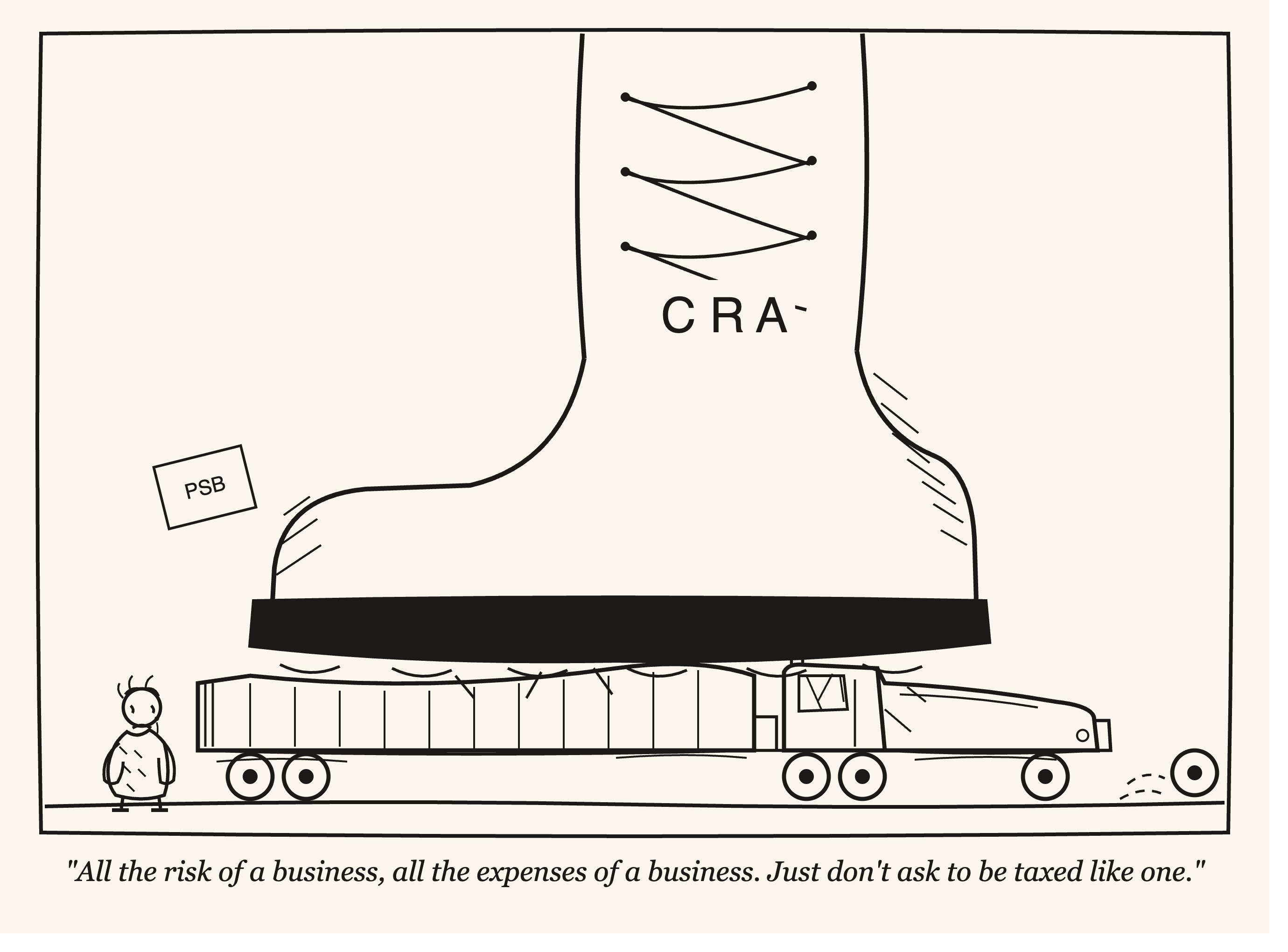
Driver Inc. enforcement was meant for incorporated drivers with no truck, no expenses and no risk, drivers who function as employees behind a corporate number, and much of the industry supported it. The owner-operators now receiving reassessments are the opposite case. They carry all the risk of a business and all the expenses of a business. A T4A database showing one payer per corporation cannot tell the two apart. The audit screen was built for one. The reassessments are landing on both.