Every trucker has asked it at some point, usually while standing at a pump watching the dollar signs stack up faster than the miles behind them:
"We live in one of the biggest oil-producing countries on the planet. So why the hell is diesel still this expensive?"
It's a fair question. Canada holds the third-largest proven oil reserves in the world. We produce more than 5 million barrels per day. We export more crude than almost any country on earth. And yet, Canadian truckers are still paying well over $2 a litre for diesel — and when things get tense in the Middle East, prices climb even higher within days.
Here's the honest answer — and it has everything to do with how the world prices oil.
The World Runs on U.S. Dollars — Including Canadian Oil
This is the part most people don't know, and it's the key to understanding everything else.
Crude oil — no matter where it's pumped from, whether it's the oil sands of Alberta, the wells of Saudi Arabia, or the fields of Iraq — is bought and sold on global markets almost entirely in U.S. dollars. This system is called the petrodollar.
It started in the early 1970s, when the United States brokered a deal with Saudi Arabia and OPEC nations: price all oil in USD, and the U.S. would provide security guarantees and military protection in return. The deal held. And because oil became a dollar-denominated commodity, every country in the world — including Canada — has to interact with the U.S. dollar every time oil changes hands.
What that means for you at the pump: even though the oil under Alberta soil belongs to Canadians, the price it fetches is set on a global market denominated in U.S. dollars. Your refinery in Edmonton doesn't set the price. Houston doesn't set the price. The futures markets in New York and London do — and they do it in USD.
When the Middle East Sneezes, Your Fuel Bill Catches a Cold
Here's where it hits home.
Approximately 20% of the world's oil supply moves through the Strait of Hormuz — a narrow chokepoint between Iran and Oman that connects the Persian Gulf to the rest of the world. Saudi Arabia, Iraq, Kuwait, and the UAE all ship through it. Iran borders it. When conflict breaks out anywhere near that corridor, traders don't wait to see what happens. They price in the risk immediately.
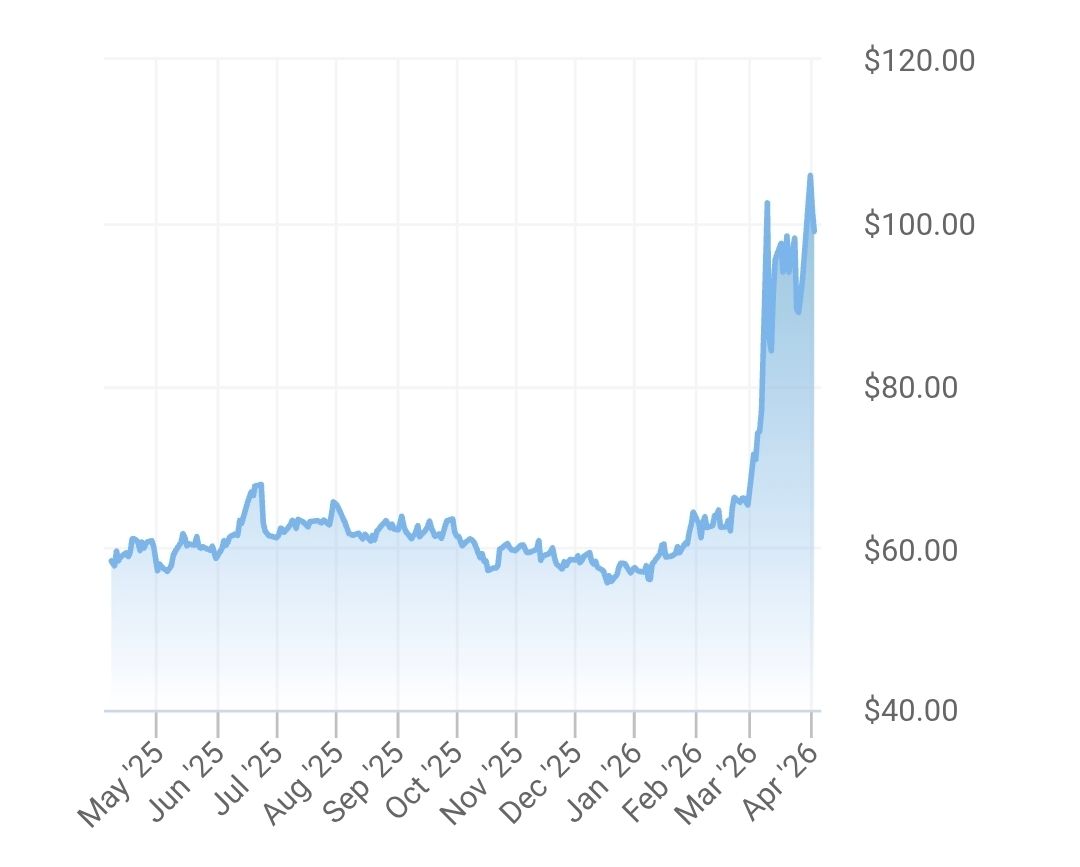
The ongoing conflict involving Iran has pushed oil prices toward and above USD $100 per barrel, the highest since 2022 when Russia invaded Ukraine. Canadian diesel prices surged nearly 30% within weeks of those tensions escalating, reaching an average retail price approaching $2.50 per litre in major markets.
You might ask: why does Canadian oil get more expensive when Middle Eastern supply is disrupted? We don't even import that oil.
The answer is that crude oil is a globally fungible commodity. There's effectively one world price, set at the margin. When supply from one region tightens, the entire global benchmark — WTI (West Texas Intermediate) and Brent Crude — moves up. Canadian crude (priced as Western Canadian Select, or WCS) trades at a discount to WTI, but it still moves with it. When WTI goes up $20, WCS goes up. And when the price of crude goes up, the cost to refine it into diesel goes up, and you feel it within days at the pump.
The Exchange Rate Problem: You're Buying USD-Priced Oil With Canadian Dollars
Here's the second punch that most people don't talk about.
Because oil is priced in U.S. dollars, Canadian refineries are essentially buying crude in USD. When they then sell diesel to you — in Canadian dollars — the CAD/USD exchange rate directly determines your final price.
Right now, the Canadian dollar is hovering around 68 to 72 cents USD. That means every American dollar of crude oil cost effectively costs Canadians around $1.40 to $1.47 in Canadian dollars before the oil even enters a refinery.
Here's how that math compounds:
- Global oil prices rise due to Middle East disruption — crude goes up in USD.
- At the same time, global uncertainty often strengthens the U.S. dollar as investors flee to safe-haven assets — which weakens the Canadian dollar further.
- So you get a double hit: oil costs more in USD and your CAD buys fewer of those USD at the same time.
A 10% rise in the U.S. dollar against the Canadian dollar alone — with no change in the underlying crude price — effectively raises the cost of your diesel by a corresponding amount. When both move against you simultaneously, the impact on the pump price can be dramatic and fast.
So Why Doesn't Canadian Oil Just Stay in Canada and Keep Prices Low?
It's a logical thought. But it doesn't work that way.
Canadian crude — particularly the heavy bitumen from the oil sands — is largely exported to U.S. refineries that are specifically designed to process it. Nearly 98% of Canada's crude exports go to the United States. Canadian refineries, meanwhile, are designed for different grades of crude and in some cases actually import lighter crude from the U.S. or overseas to blend with Canadian heavy oil.
Beyond the refinery infrastructure issue, Canada's domestic fuel pricing is still pegged to global benchmarks. A barrel of oil sitting in Alberta could theoretically be sold domestically at a discount, but energy companies are price takers in a global market — they will always sell where the price is highest. There is no mechanism that forces Canadian crude to become cheap Canadian diesel.
Add in federal and provincial fuel taxes, carbon levies, refinery margins, and distribution costs, and you have a pump price that is largely disconnected from the romantic notion of "we have oil, therefore fuel should be cheap."
What This Means If You're Running a Rig Right Now
For owner-operators and small fleets, the compounding effect of global oil pricing, Middle East instability, and a weak Canadian dollar is brutal. Diesel is typically the single largest operating expense on a truck — often 30 to 40 cents of every revenue dollar earned. When that cost spikes 25 to 30% in a matter of weeks, there is no easy place to absorb it.
A few things to keep on your radar:
Watch the USD/CAD rate, not just the pump price. If the Canadian dollar weakens significantly — which it tends to do when global uncertainty rises — expect diesel to follow regardless of what crude oil itself is doing.
Lock in fuel surcharge conversations with brokers and shippers early. When prices move fast, outdated rate agreements become your problem, not theirs.
Monitor the Strait of Hormuz situation. Any significant escalation in the Gulf region will be priced into fuel within 48 to 72 hours. It is not an overreaction to factor geopolitical risk into your fuel planning.
Consider fuel hedging if your volume justifies it. Some larger carriers use forward contracts or fuel programs to cap their exposure. It's worth a conversation with your accountant or fleet manager.
The Bottom Line
Canada has more oil in the ground than almost any country on earth. But that doesn't make Canadians immune to global energy markets — it makes them participants in them. The petrodollar system means crude is priced in U.S. dollars worldwide. A weak Canadian dollar multiplies the hit. And when a conflict thousands of kilometres away threatens to close a strait that most Canadians couldn't point to on a map, it shows up in your fuel bill within the week.
It's not a Canadian problem. It's not a government conspiracy. It's the architecture of the global energy economy — and until that changes, every trucker in this country is riding it whether they want to or not.