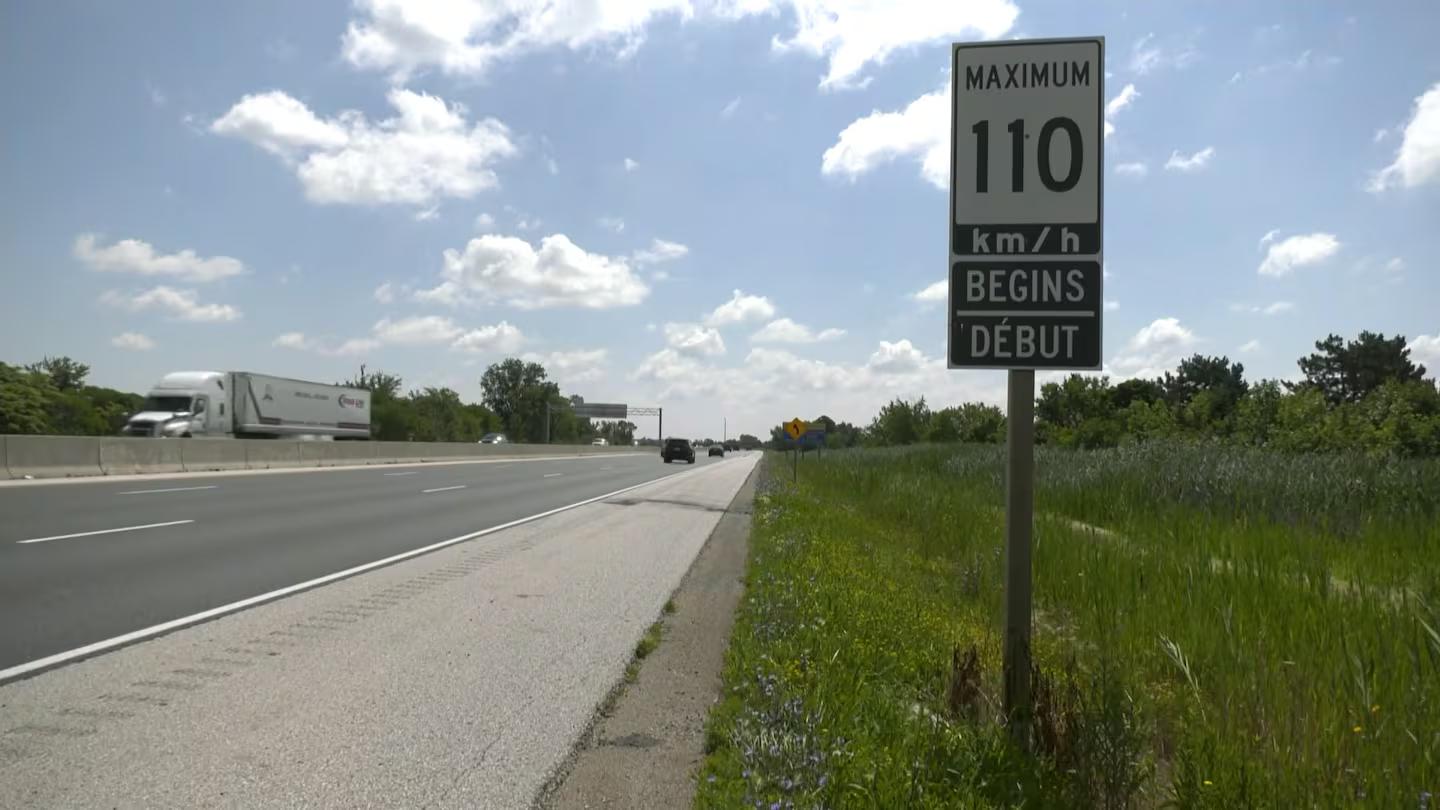
Ontario is raising the posted speed limit to 110 km/h across most of its provincial highway network, but the trucks sharing those lanes won't be going any faster. Heavy commercial vehicles stay governed at 105 km/h under the province's speed-limiter law, so for carriers the change does nothing to shorten the trip — it simply widens the gap between car and truck speeds.
The expansion is sweeping. The province is adding 110 km/h limits to another 938 kilometres of highway, which Premier Doug Ford says will lift the share of the network posted at 110 to nearly 89 per cent by October, up from 43 per cent today. The rollout is staged: the first phase took effect June 26 on sections of Highways 401 and 416 in eastern Ontario, with stretches of the Queen Elizabeth Way and Highways 400, 401, 402, 403, 416 and 417 following on set dates through September 30.
The province is selling the move on time. Transportation Minister Prabmeet Sarkaria estimates drivers will save about 20 minutes between Sarnia and Toronto and close to 30 minutes from Toronto to Ottawa. The higher limits, the government stresses, are going up only on corridors that have cleared rigorous technical reviews and any infrastructure work needed to handle the faster traffic safely.
For trucking, though, the number that matters is the one that isn't moving. Since 2009, Ontario has required heavy trucks — those with a manufacturer's gross vehicle weight rating over 11,794 kg — to run a speed limiter set to no more than 105 km/h, and Quebec enforces a matching rule. The new posted limits leave that mandate untouched, a point the Ontario Trucking Association moved quickly to make: the increase has no application to heavy truck speeds.
What the change does create is a wider speed differential. On corridors now posted at 110, cars can legally pull away from even the fastest governed truck, and that gap only grows when passenger vehicles drift above the limit. Bigger spreads between the quickest and slowest traffic mean more lane changes and more passing around trucks — exactly the kind of interaction safety researchers watch on multi-lane highways.
The upside for fleets is that nothing about the work itself changes. Because trucks were already capped at 105, schedules, fuel burn and hours-of-service math on these routes stay the same; only the traffic around the truck speeds up. The practical takeaway for drivers is to plan for that wider differential — a little more following distance and extra caution merging onto the 400-series — as the new limits roll out through the fall.
The limiter mandate itself is settled ground. It survived court challenges after taking effect, the OTA and the Ministry of Transportation continue to enforce it together, and the province credits it with a sharp drop in fatalities involving large trucks. For now, Ontario's faster highways are a win aimed squarely at passenger traffic.
Image Credit: CTV News