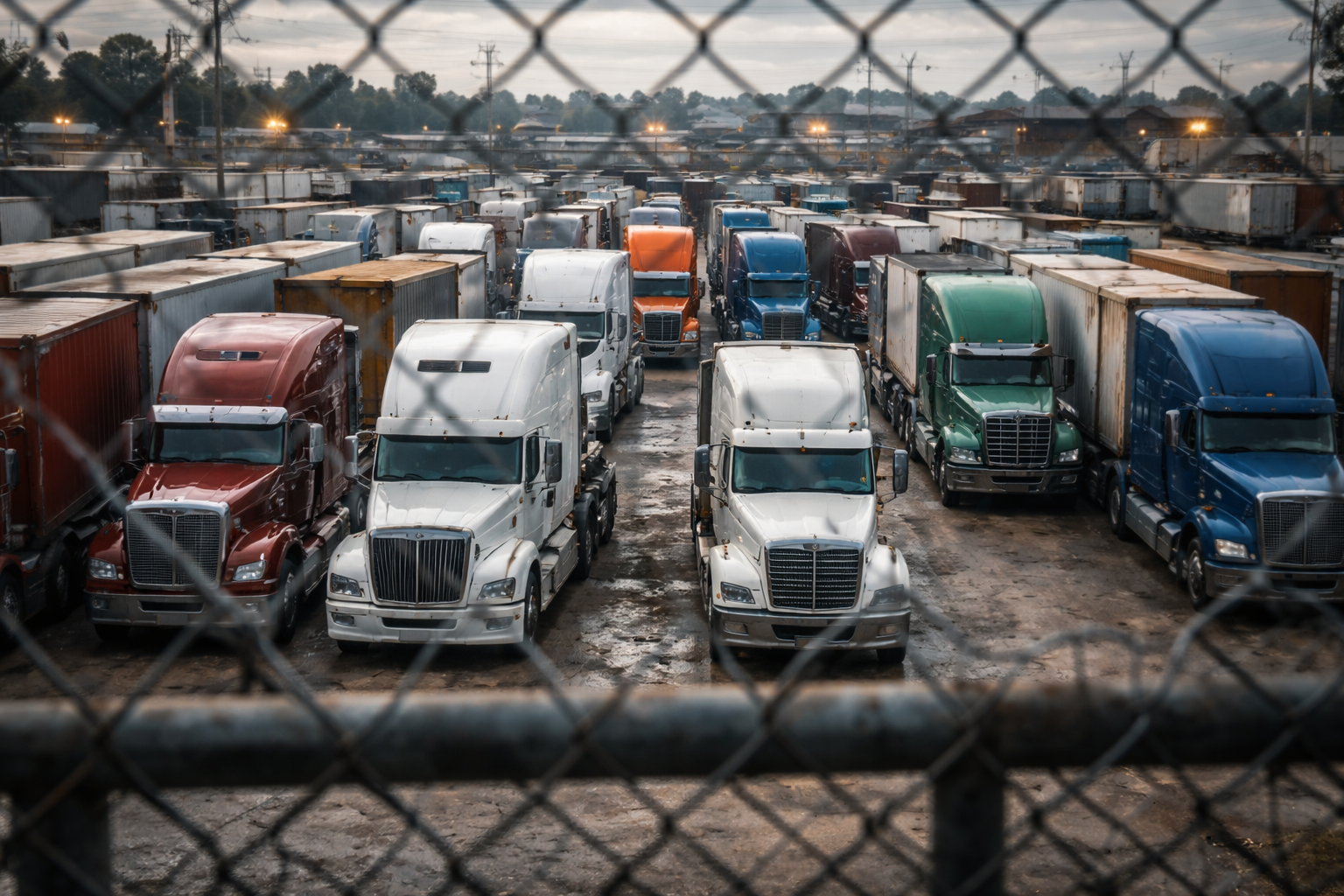
You've seen it. A flatbed or reefer parked halfway on a curb on some industrial side street in Brampton. Dropped trailers sitting in plaza parking lots for weeks. Bobtails wedged between rows of cars at a Mississauga truck stop that ran out of spots hours ago. It's not laziness or disregard for the rules — it's desperation. Truck parking in the GTA and Peel Region is in full-blown crisis, and the gap between what drivers need and what exists on the ground keeps getting wider.
The Numbers Don't Lie
Brampton alone is home to 24,000 businesses classified in transportation and warehousing, contributing roughly 11 percent of the city's GDP. That's an enormous logistics footprint for a municipality that has never built the parking infrastructure to match it. Long-haul drivers coming off the 401 corridor, owner-operators finishing a late run, and local drayage drivers between loads all need somewhere safe and legal to put their equipment overnight or between shifts. That somewhere barely exists.
Long-haul drivers regularly describe being forced to park on the street after failing to find a legal spot at a Mississauga truck stop — running out of drive time with nowhere else to go. That's not an edge case. That's Tuesday night in Peel Region.
Residents Have Had Enough — And They're Not Wrong
Here's the uncomfortable truth: the complaints from residents and neighbourhood associations are legitimate. Illegally parked semis and dropped trailers on residential streets create real problems — blocked sight-lines, noise from idling engines, diesel fumes, and the general feeling that your street has become a staging yard.
Residents across Peel have rallied against the proliferation of illegal truck yards in the region, and city staff in Brampton have pushed back hard against informal operations that have expanded into lands not zoned or designed for heavy vehicle storage. Planning documents are clear that these employment lands were meant to support competitive, functional business areas — not open-air trailer lots.
The City of Toronto acknowledged in planning reviews that commercial vehicles, by virtue of their size, can constitute a visual nuisance and generate noise, vibration, odour, and air quality impacts that are legitimate concerns for nearby residents.
Residents didn't sign up to live next to a truck yard. That's a fair position. The problem is that the industry's need for parking didn't disappear just because no one wanted to deal with it.
A Patchwork of Band-Aids
The policy response so far has been reactive at best. Brampton City Council passed a motion years ago directing staff to work with private landowners, the Peel Goods Movement Task Force, and the trucking industry to identify locations suitable for truck parking and storage. Progress has been slow.
Brampton's Municipal Parking Plan committed to assessing truck parking needs and recommending policies through the Official Plan, with input from stakeholders including the Ontario Trucking Association, South Asian Trucking Association, and owner-operator groups. The right table has been set. The food still hasn't arrived.
More recently, a Brampton committee recommended changing bylaws to allow trucks to use under-utilized areas at existing industrial sites — a practical and overdue step. But bylaw changes move slowly, and the parking problem is happening right now, every night.
What Actually Needs to Happen
The frustration on both sides — from drivers who can't find a spot and from residents who don't want trucks on their street — comes from the same root cause: no one planned for this scale of logistics activity when these communities were built. That planning failure now needs a deliberate fix. A few practical paths forward:
Dedicated truck parking facilities near highway interchanges. Industrial land near the 401, 407, and 410 corridors — particularly in Caledon, Milton, and the outer edges of Brampton — should be fast-tracked for secured, purpose-built truck parking. Lit, fenced, with basic amenities. These aren't glamorous projects, so they get deprioritized. They shouldn't be.
Underutilized industrial site activation. Allowing trucks to use vacant portions of existing industrial properties is low-hanging fruit. Landowners get revenue, drivers get legal spots, and no new land is needed. Approve it, implement it, enforce the conditions.
Provincial coordination on rest stops. The 400-series highway network has almost no truck-safe rest infrastructure compared to U.S. equivalents. Queen's Park needs to treat this as a transportation infrastructure issue, not just a municipal land use headache.
Enforcement with a realistic outlet. Ticketing trucks parked illegally without providing legal alternatives is not a solution — it just cycles the problem. Enforcement makes sense when there's somewhere to send drivers. Until then, it's theatre.
The goods that stock every shelf in Peel Region arrive by truck. The drivers moving those goods need somewhere to park that isn't a residential street, a mall lot, or someone's lawn. Solving this isn't about choosing between truckers and neighbourhoods — it's about accepting that both have legitimate needs and that the region has been avoiding the infrastructure investment required to honour both.
The parking crisis didn't appear overnight. Neither will the fix. But it won't fix itself either.